
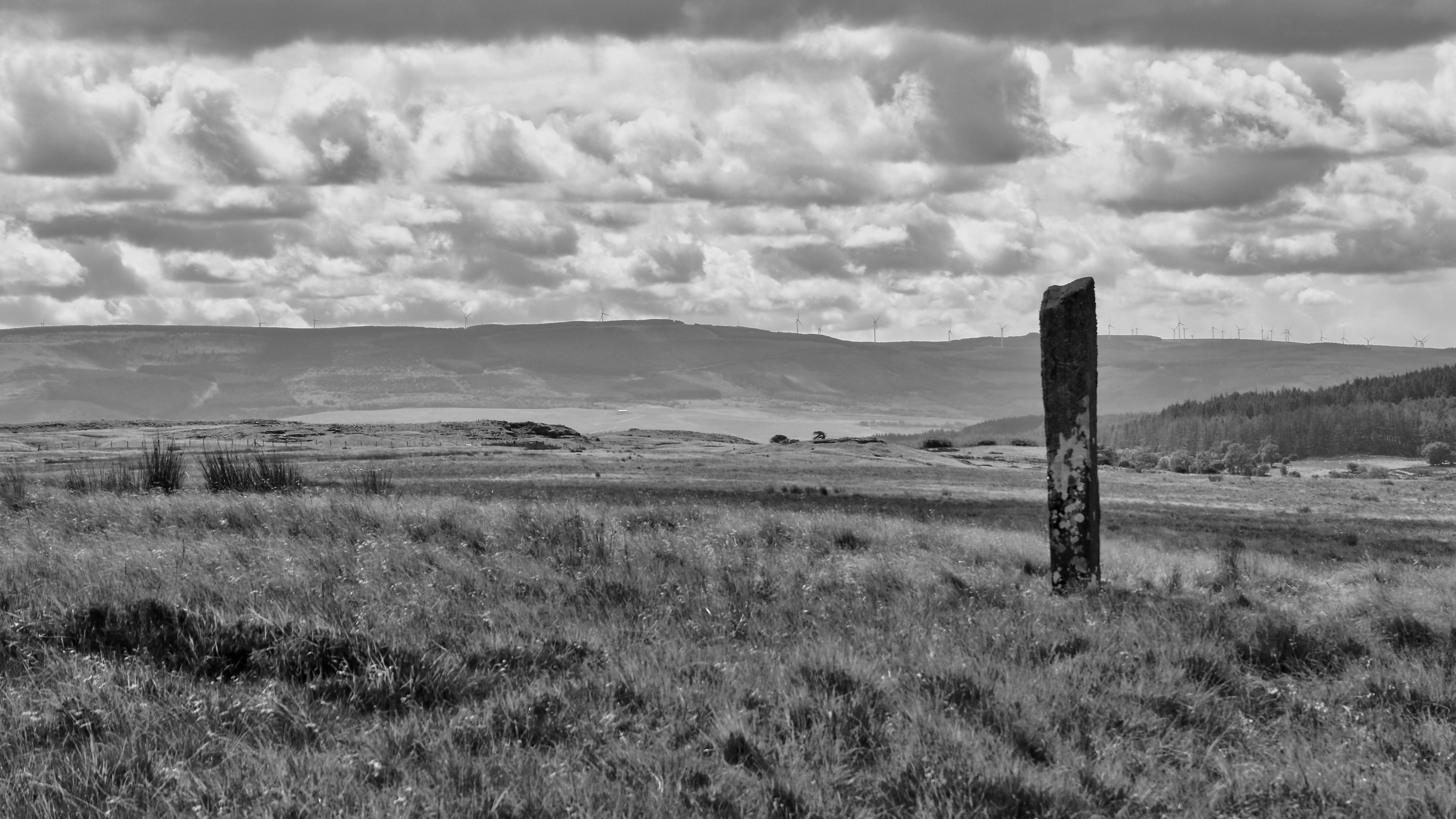
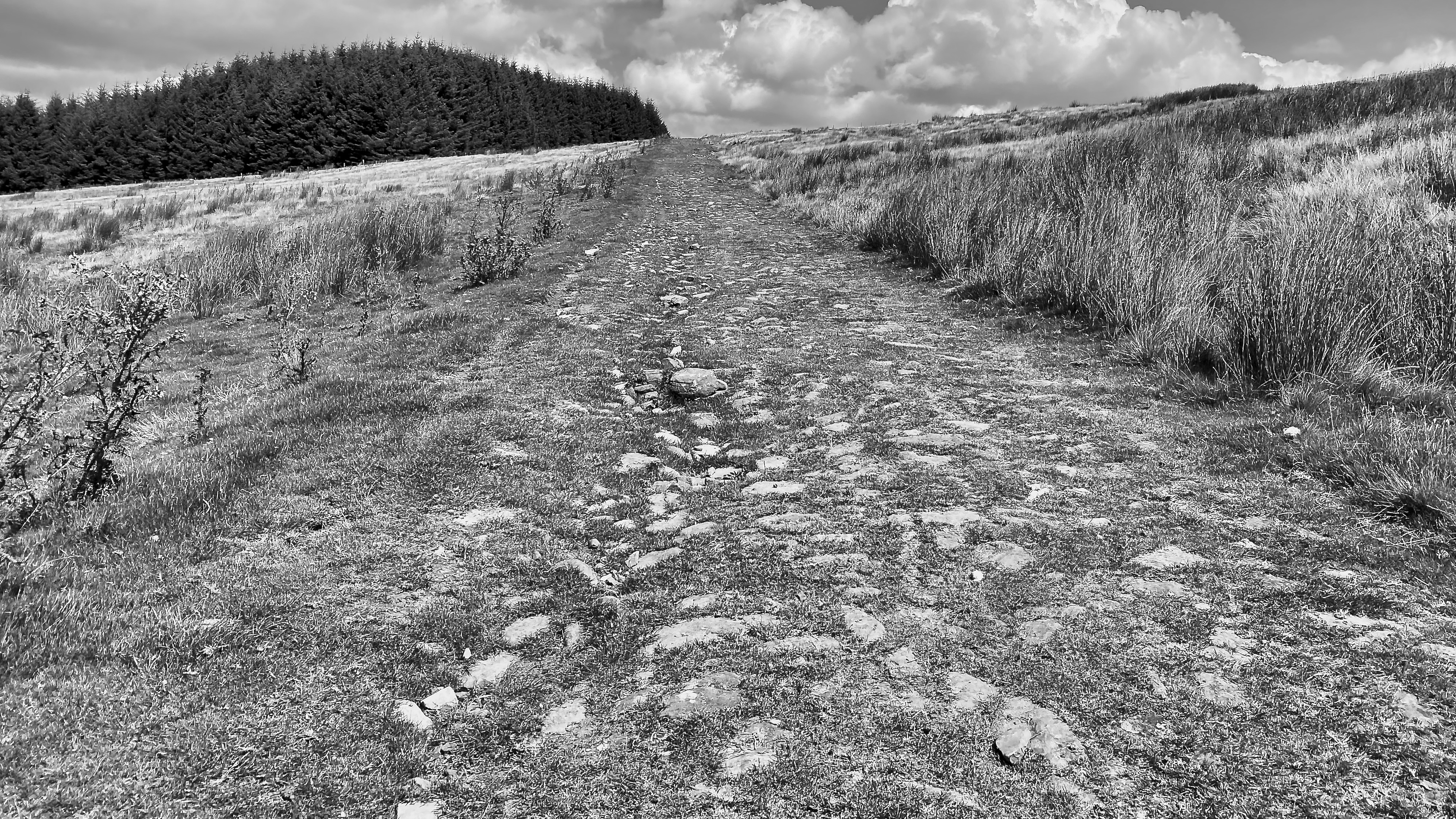
Standing on an old metalled track just north of Ystradfellte and looking around it is easy to feel isolated and long way from anywhere. Surrounded by moorland stretching into the distance on one side and modern conifer plantations on the other and Fan Llia dominating the skyline to the north, it is easy to imaging that it was always like this. But the sensation of quiet isolation today was probably not the experience of people who lived and travelled here in the past. This is evidenced by the fact Aunty and I are standing on the route on a Roman Road, Sarn Helen, laid down in the first century linking the forts at Neath to the south and Brecon Gaer to the north, before continuing to the north coast of Wales. The road is named after the fourth-century princess turned saint, Elen Luyddog, according to the Mabinogion, a collection of Welsh myths which may or may not have a basis in fact. However, the historical accuracy of this attribution is easy to dispute, as the Romans established their roads in Britain in the first century, long before Saint Elen could have influenced her husband Macsen Wledig to undertake it’s construction.
Macsen Wledig, or Magnus Maximus, was an historic person though. A Roman general, he was born in Gallaecia, which is now known as Galicia in northwest Spain. He played a prominent role in the Roman army, especially in the province of Britain where he was stationed from 363 CE as a junior officer, and distinguished himself during the Great Conspiracy in 368 when the Pict, Irish and Saxons attacked at the same time over running Hadrian’s Wall and much of the Northern part of Britain. This invasion was prompted by the withdrawal of a large contingent of the army from Britain by the British Legions raising a number of usurpers to be emperor. Each time soldiers left Britain to fight for the usurpers inevitable on mainland Europe. All of which came to nothing. Eventually, after a few years the Roman legions brought the area back under control.
However, in 383 CE, Magnus Maximus was the next in line to attempt to usurp the title of Emperor. And following a now familiar pattern he took the majority of the British garrison in Gaul where they fought against and beat the incumbent emperor Gratian. After negotiating with the Eastern Emperor Theodosius, Maximus took control of Britannia, and Gaul, while Valentinian II, Gratian’s brother, remained in charge of Italy, Spain, Pannonia, and Africa. However, Maximus’s reign ended in 388 CE when Theodosius’ forces defeated him in the Battle of the Save. He was then captured and executed in the city of Aquileia. In Welsh tradition, he is known as Macsen Wledig, and is the central character of the Mabinogion story, Breuddwyd Macsen Wledig (The Dream of Macsen Wledig). But more on that at another time.
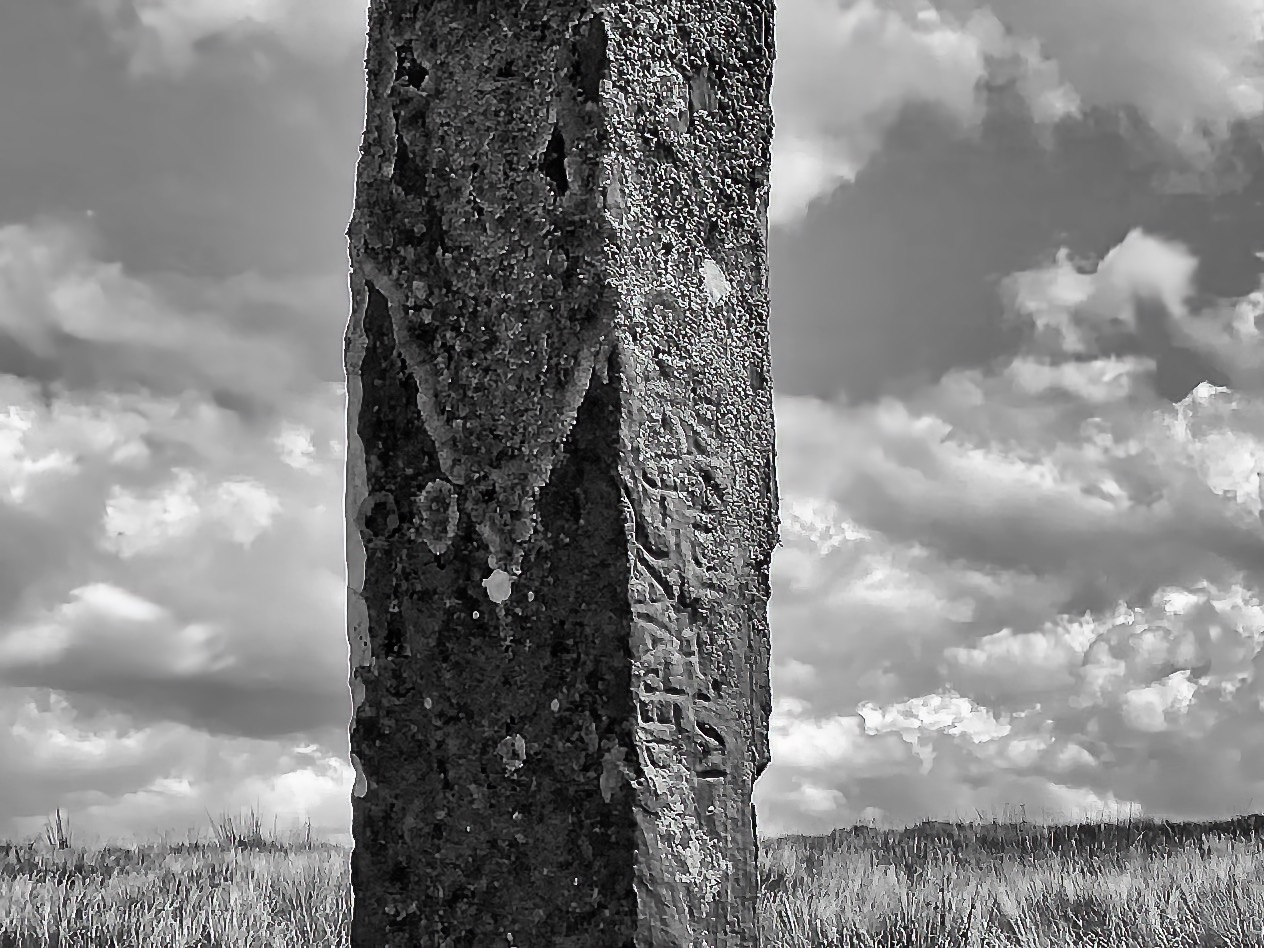
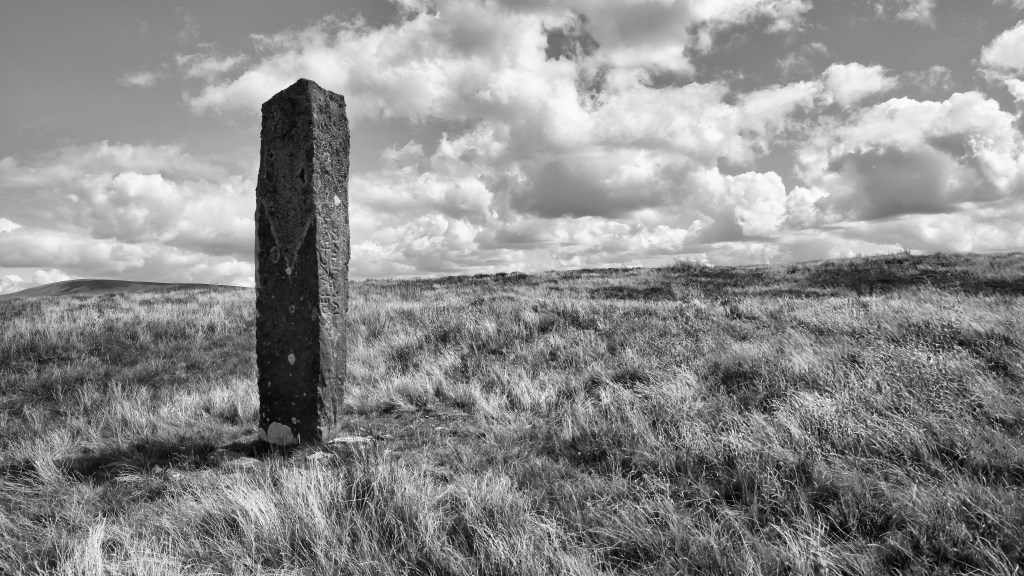
We have passed the memorial on a number of occasions on different walks, but it seems that it was placed to be read when approaching from the south-east, walking up the slope towards it from the Cwm Nedd. Currently standing at 2.8m high it is a tall thin column of red sandstone covered in parts with lichens, almost as if it’s trying to hide against the grey sky behind. The inscription is on the narrowest edge, and is easily visible as you approach the stone.But it can be difficult to read as it flows unsteadily downward the thin edge:
DERVAC-FILIUS / IUST – (H)IC IACIT
This “has been translated as “ (The stone) of Dervcus, sone of Justus. He lies here”. This is clear evidence of the need to create a memorial to someone once loved. Who Dervacus was we’ll never know, but is is clear that he was alive and ended his days near here soon after the end of the Roman occupation of Britain. Dates are notoriously difficult to pin down during this period but Maen Madoc is thought to mark a late Roman or more likely an early post-Roman Christian burial, reflecting the transition period between pagan and Christian practices in Wales. The term “IACIT” does point to an early Christian burial or memorial. This was a time of great change and uncertainty in Britannia.
After Maximus left with the remains of the Roman army Britannia was essentially left to defend itself. The push by the Anglo Saxons from the east pressurising the populations in what is now England, coupled with the increasing attacks and settlement of west and north Wales by the Irish must have created a series of power vacuums throughout Wales. But changes were also occurring in nearby France with the Goths invading Gaul, and so there may have been refugees coming over the seas from there. Dervacus does not appear to be a local name, so was he an incomer escaping from another area, forced out by tribal movements in Gaul? I have no evidence of this other than my fanciful imagination – so please don’t quote me!
It has been suggested that because it was erected on a false summit making it more visible when approached from the South-west it could indicate that before he died Dervacus may have come from a community of this side of the valley1.
This time of change and political uncertainty can be witnessed in the creation of the inscription itself. The Latin inscription is poorly executed, with some of the letters sideways or upside down. This may show that the stone mason had a poor knowledge of Latin, and so too may have the individuals who commissioned the memorial.
Walking along the track the stone stands in splendid isolation about 5m from the current route. If you look closely it is possible to see a cobbled platform surrounding the stone. However, not all is at it first seems. This is not the original position of the stone, nor is the current track the original route of Sarn Helen. However, the fact that the stone was erected close to the edge of a Roman road does indicate the continuation of the Roman tradition of burial next to a road, even though this is Christian burial from the 5th or early 6th century.
The stone was last resurrected in 1940 after having fallen. During this work an excavation showed that the platform within it stood and the current position of the stone was not its original site. Excavations of the area discovered that the current trackway or road is not the original Roman Road. Fox uncovered the original Sarn Helen and found it south east and running parallel. The excavation also found the original site of the memorial 5.28m away and on the north west edge of Sarn Helen 2. However, Fox was unable to find any evidence of a burial near this area. Maybe this is no surprise considering the acidic nature of the geology and soil on the moorland, and any remains would have decomposed completely. Further up the track are the remains of a Roman camp, but this is now hidden with the conifer plantation. We did have a look but it was too well hidden for us to find.
It has been suggested that the current track was laid by farmers and landowners to ease the transport of coal from the Neath Valley to the south. Coal was used initially to burn limestone to create lime and sold to the iron works, or could be used to fertilise and ‘sweeten’ the fields, making them more productive. Fox mentions that the stone has been only been recorded relatively recently in 1774, and there is a suggestion that it had fallen a long time before this. This suggests that the fallen stone could have been discovered when building the road.
According to Fox, the history of the stone and its surroundings can be divided into several periods.
Period I. The Roman road, which was likely constructed in the first century and used until the sixth century, and possibly even later.
Period II. After falling into disuse, the route of the Roman road became overgrown and lost. The Dervacus stone fell for the first time, but the exact date is unknown.
Period III. The route was reopened due to coal traffic, resulting in the creation of holloways on the slopes. During this time, the Dervacus stone was discovered lying down. This period lasted until around 1813.
Period IV. Sarn Helen was further reconstructed and transformed into a metalled road, but it mainly followed the approximate line of the original Roman road because the original road was no longer visible. The Dervacus stone was likely relocated to a new site between 1820 and 1850.
It has been suggested that the memorial was not its first use for the stone. It seems likely that such a striking stone could have been used during the Bronze Age as a marker stone. And not far from here is another large standing stone, Maen Llia which really is a huge and readily visible stone. And one you have to visit if you are in the area. However, it remains unclear if Maen Madoc is a rested prehistory monolith as there was no evidence of this during the archeological excavations3.
So where does that lead us? Only to the point that we know that Sarn Helen passed this was. After the Romans had left Britain, major societal changes were taken place, and during the 5th or early 6th a man called Dervacus dies, and his son raised a memorial stone to him. But was you contemplate the column if remains silent. It has no language to tell us all that it has been over the centuries and so we are left with conjecture beyond the limited facts that archeology can serve us. Today it feels isolated as it stands witness to changes around it, but it was not always so. So tonight I’ll raise a glass to Dervacus and his loyal son Justus. Cheers!
- Burnham,H. (1995) A guide to Ancient and Historic Wales: Clwyd and Powys. Cadw. ↩
- Fox,C. (1940) The re-erection of Maen Madocm Ystradfellte, Breconshire. Archaeologia Cambrensis. 95:210-216. https://journals.library.wales/view/4718179/4738936/285#?xywh=-3392%2C-45%2C9717%2C3941 Access 16 Jan 2024. ↩
- Leighton,D. (2012) The Western Beacon Beacons: The archeology of Mynydd Du and Forest Fawr (2nd Ed). RCAHMW. ↩
 Travels With My Aunt
Leave a comment