
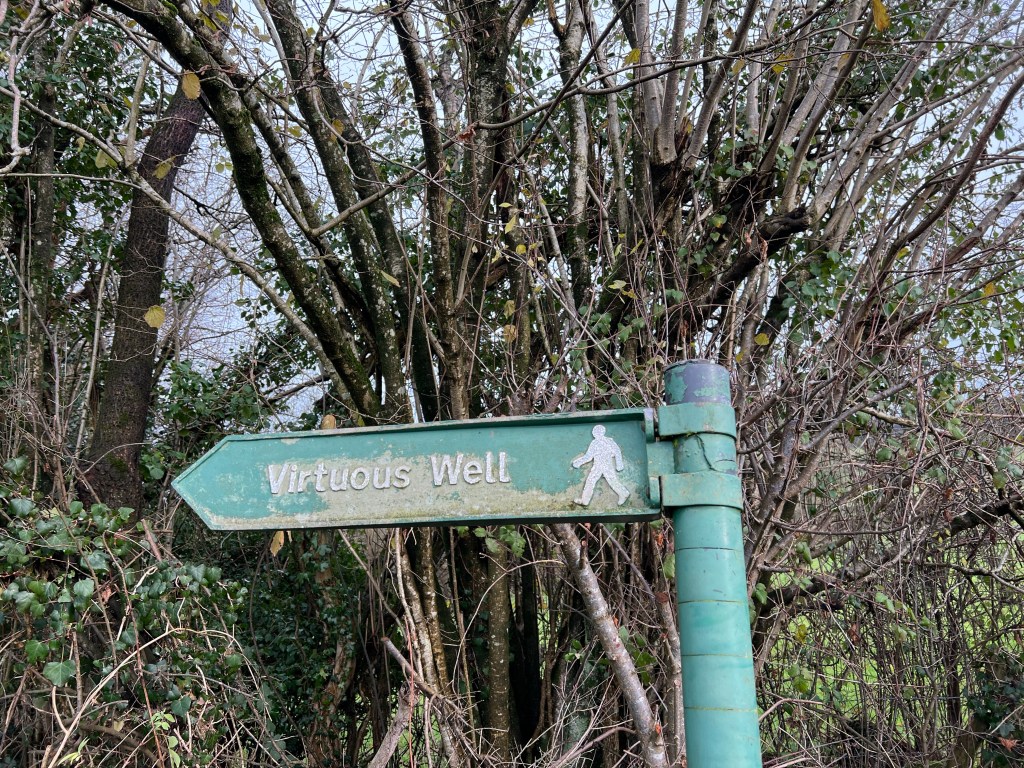
The path narrowed quickly as I leave the road at Trellech, slipping between hedgerows stitched with fern and moss below the bare winter trees and hedges. The village fell quiet behind me, the quiet only disturbed by a car passing me out of the village and the sounds of roofers replacing a roof on a cottage along the lane.. Ahead, the ground dips gently, and I spot an old green sign pointing out the way though a metal gate between the hedges. Nothing announces itself. There is no grand reveal, no spectacle. Instead, the well asks you to approach and stop, to look more closely, to listen. It has always done so.
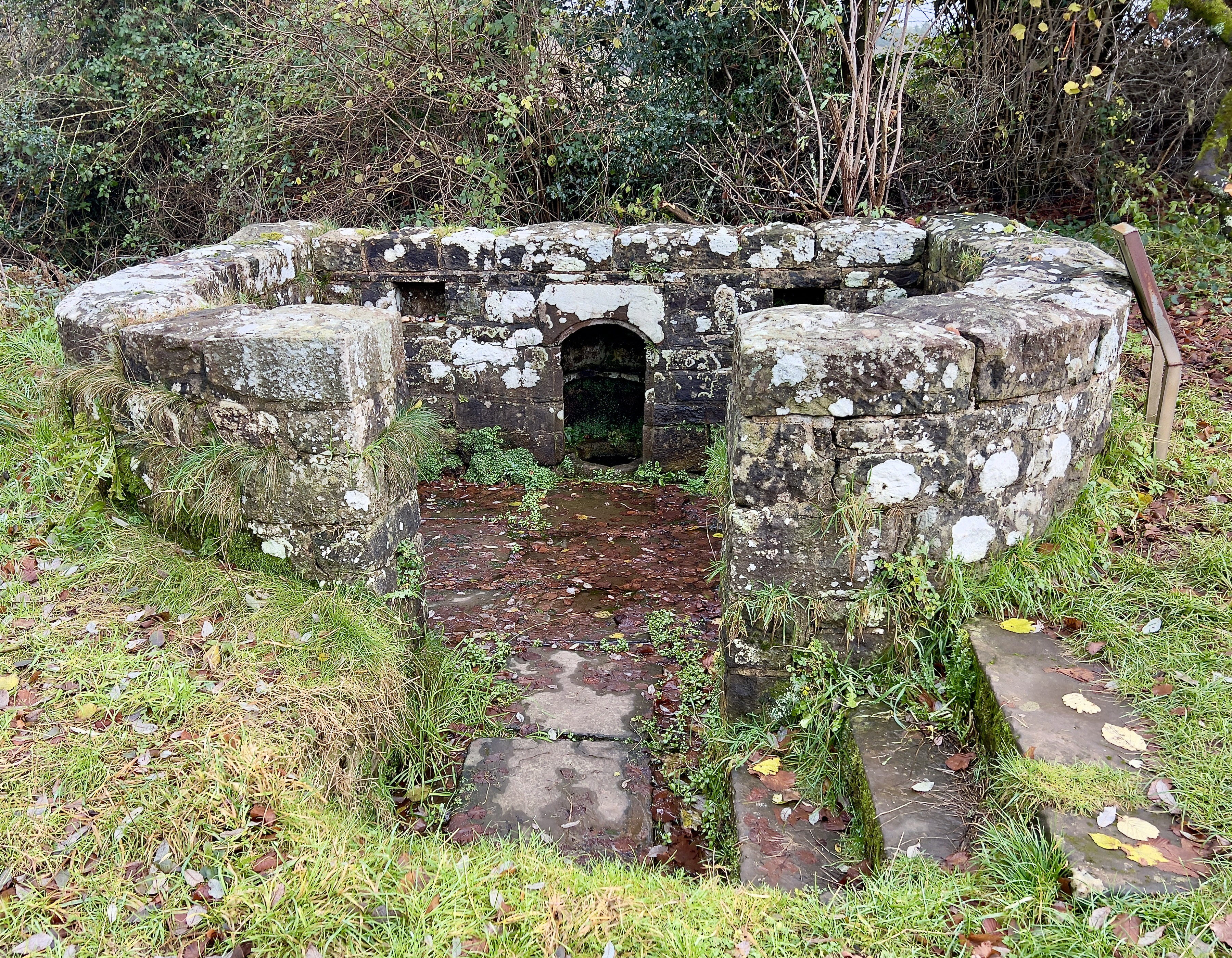
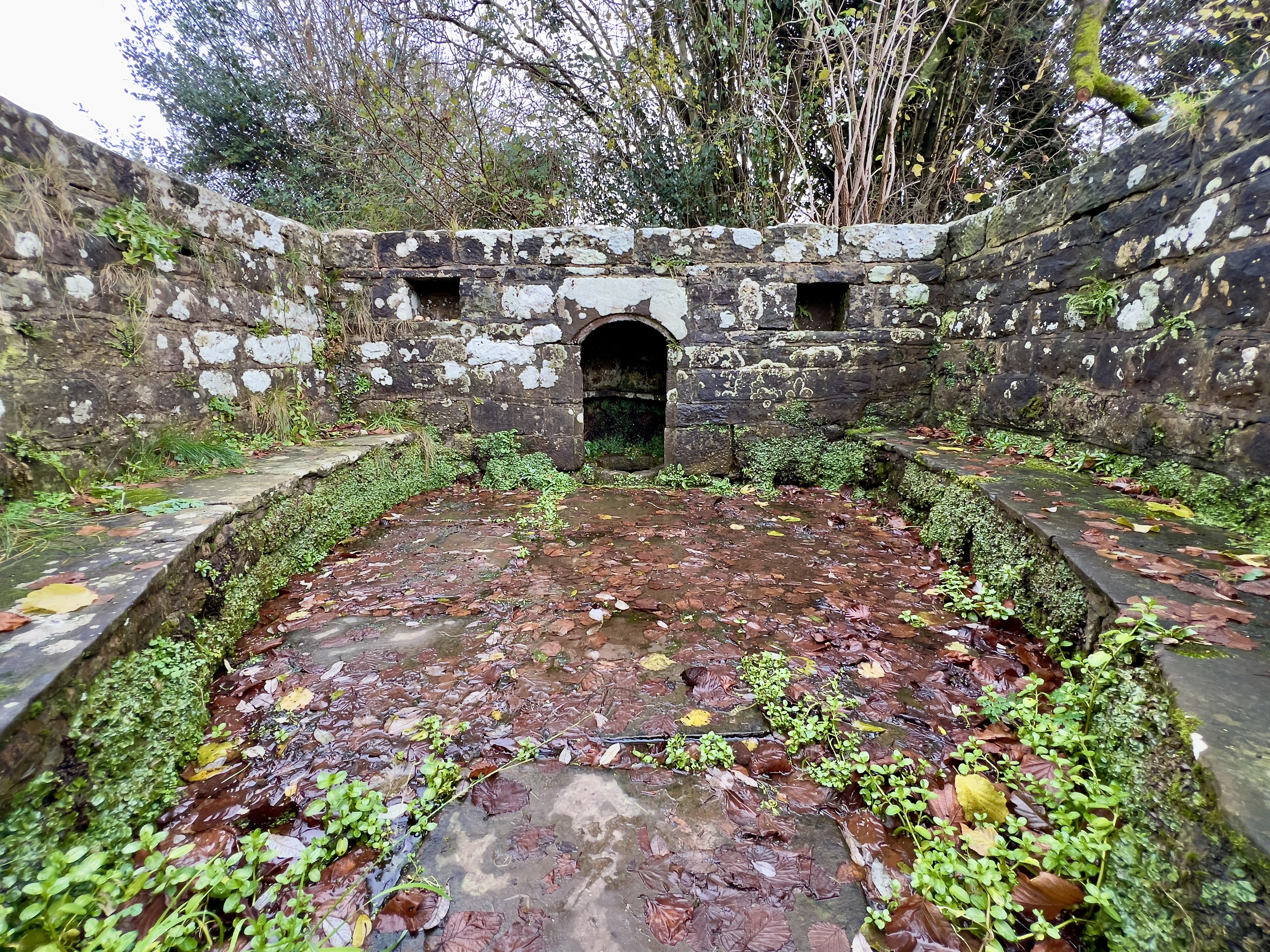
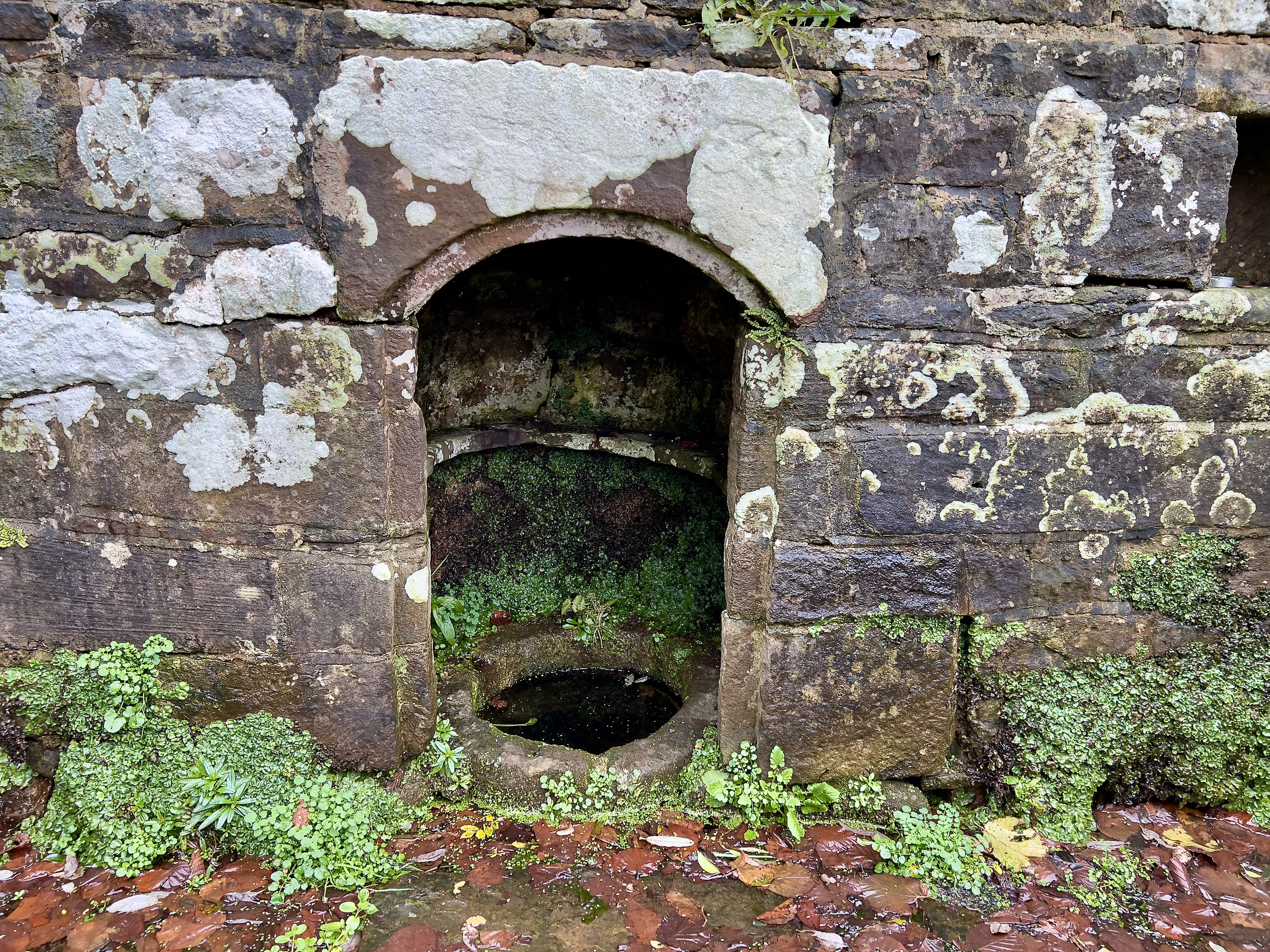
The Virtuous Well lies cupped within a hollow of old masonry, its stonework softened by centuries of weather and touch. Water gathers in a shallow basin, clear enough to reveal the base of the well beneath the water surface. In damp weather the stones darken almost to black; in sunlight they glow honey-grey. Lichens map their slow empires across the surface of the stonework, jostling for position with Snakeskin Liverwort. Leaves drift, settle, and are quietly drawn away again. I was the only visitor and I had a real sense of enclosure here, as though the place prefers attentiveness to noise.
Origins and Deep History
The precise beginnings of the Virtuous Well are difficult to pin down, and honesty demands that we begin with uncertainty. No inscription tells us who first marked this spring, no written record names its earliest keepers. Yet the very nature of the place offers clues.
Natural springs held deep significance across prehistoric Britain, particularly in regions like Monmouthshire where limestone geology allows groundwater to emerge clean and reliable from the earth. Archaeological evidence from across Wales and the Marches shows that such places were often revered long before the arrival of Christianity. Springs were liminal: places where unseen waters crossed into the human world, where the earth seemed to offer sustenance directly.
At Trellech, the well’s siting suggests careful attention rather than accident. The spring is framed, contained, and given form by stonework that—while altered and rebuilt over time—implies long-standing recognition. Nearby, the landscape bears other marks of deep time: prehistoric standing stones, later medieval earthworks, and the layered settlement history of the village itself. The well sits comfortably among these, neither isolated nor incidental.
Whether the Virtuous Well was sacred in the pre-Christian sense cannot be proved, but its character aligns closely with sites that were. What can be said with confidence is that by the medieval period it was already regarded as ancient, its reputation established enough to be inherited rather than invented.
Sacred Meaning and Belief
Why did people consider this water special? The answer lies partly in the universal symbolism of springs, and partly in local belief. Water that rises from the ground without visible source has long been associated with healing and renewal. It cleanses not only the body but the spirit; it marks beginnings. In folk belief, such water is often thought to carry the essence of the land itself—balanced, restorative, morally neutral yet potentially transformative.
The Virtuous Well’s very name speaks to this understanding. “Virtuous” in its older sense implies potency or efficacy rather than moral judgement. The water was believed to do something. Local tradition held that it could aid healing, particularly of the eyes and skin, though as with many such claims, details vary depending on who is telling the story and when.
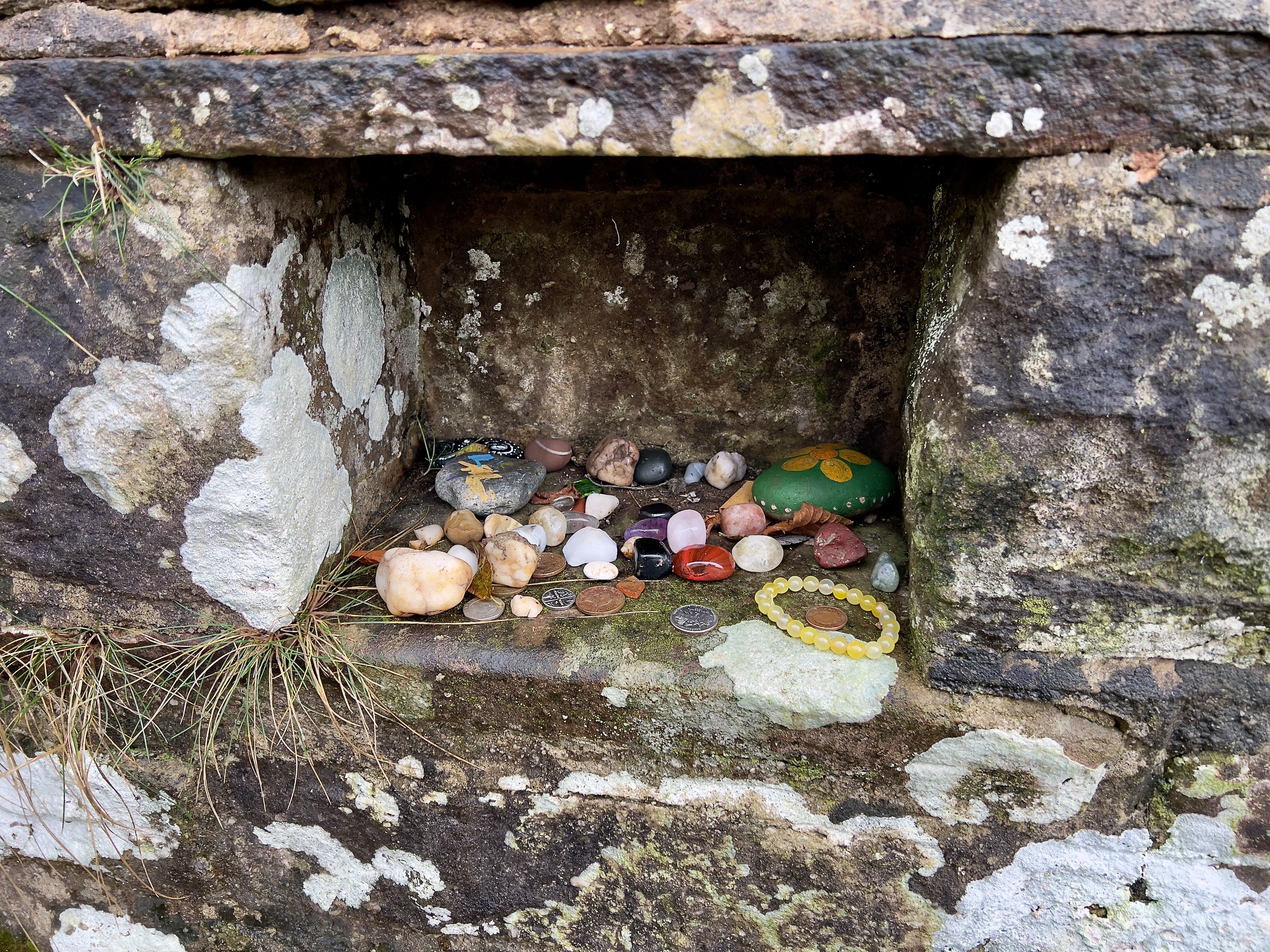
Offerings were once left here—coins, pins, scraps of cloth—gestures of exchange rather than payment. The act mattered more than the object. Such practices were never formally recorded at Trellech, but they mirror customs documented at wells throughout Wales and the west of Britain, suggesting a shared grammar of belief rather than an isolated superstition. Today offerings are still left in a small alcove in the surrounding stone wall. Even today this place still has meaning to people.
A dedication to Saint Anne
The well has been dedicated to St Anne. But who St Anne in this case was is open to conjecture. The board by the well suggests that St Anne is linked to Antis, Celtic Goddess of rivers, water, wells, magic and wisdom. It was later Christianised to St. Anne mother of the Virgin Mary.
Another possibility is that the Virtuous Well is closely intertwined with the life of a remarkable early Christian woman remembered in Welsh tradition as Saint Anna of Trellech. Although the details of her life are filtered through early hagiography and later legend, enough fragments survive to suggest that she was a real historical figure whose influence reached across both south-east Wales and the English borderlands.
Our earliest reference to Anna comes from the Life of Saint Samson, written around fifty years after the saint’s death in the late sixth century. By the standards of early medieval saints’ lives, this relatively short gap lends the account a degree of credibility. In this biography Anna appears not as a shadowy legend but as a woman of noble background, said to have been born into a prominent family of the kingdom of Gwent.
Later medieval tradition embellishes her story considerably. In these accounts Anna is said to have married Cynyr Ceinfarfog, remembered as the lord of Caer Goch in Dyfed. The couple were credited with a large and influential family. Among their children was Saint Non, who herself became the mother of Saint David. Through this lineage Anna becomes part of the extended spiritual family surrounding Wales’s most famous saint.
Legendary material from the same period weaves her household even more deeply into early British mythology. Anna was said to have a stepson, the Arthurian warrior Cai—known in Welsh tradition as Cai Hir, “the Tall.” Some versions of the tale go further still, claiming that Anna and Cynyr acted as foster-parents to the future king King Arthur during his youth. Such claims belong firmly to the realm of legend, yet they show how closely the traditions of saints and heroes became interwoven in medieval Welsh storytelling.
The Life of Samson, however, offers a more grounded account of Anna’s later life. After the death of her first husband, she is said to have married a distinguished official of the royal court of Dyfed named Amon of Dyfed. Their son, Samson, would grow to become one of the most influential church leaders of the Celtic world, eventually serving as bishop and missionary across Britain and Brittany.
Samson’s influence extended even to his own parents. According to the biography, he persuaded both Anna and Amon to dedicate their lives to the Church. Amon entered monastic life on Caldey Island, known in early sources as Ynys Byr. Anna, meanwhile, returned eastwards to her native Gwent. It was during this period that the sacred spring at Virtuous Well appears to have been dedicated to her, suggesting that the site originally honoured St Anna before later traditions associated it with other saints.
Anna’s religious influence was not confined to Wales. She is also credited with founding early Christian communities further east, in what is now Gloucestershire, including churches at St Anne’s Church and St Anne’s Church. Samson himself is said to have visited his mother at Oxenhall and formally dedicated both of these foundations. Another possible echo of her memory survives in the holy well known as St Anne’s Well, traditionally called “St Anne in the Woods.”
As with many early saints, later genealogists attempted to link Anna to royal lineages. One theory identifies her with a daughter of Vortimer Fendigaid, ruler of the region corresponding roughly to modern Gwent. Unfortunately, this connection rests largely on the writings of the eighteenth-century antiquarian Iolo Morganwg, whose imaginative reconstructions of Welsh history are now treated with considerable caution.
Despite these uncertainties, the tradition of St Anna herself is much older. References to her appear as early as the seventh century, suggesting that behind the layers of legend there was indeed a historical woman whose memory was preserved in the landscape of early Christian Britain. The Virtuous Well, quietly flowing beneath the wooded slopes near Trellech, may therefore commemorate not only a sacred spring but also one of the remarkable women who helped shape the earliest Christian communities of Wales and the borderlands.
Folklore, Myth, and Oral Tradition
The stories attached to the Virtuous Well are quiet ones. There are no dragons lurking in its depths, no curses for the unwary. Instead, the folklore is intimate, human-scaled.
One oft-repeated tale speaks of a blind or partially sighted pilgrim who washed their eyes in the water and regained vision. In some versions, the healing is immediate; in others, it unfolds slowly, as patience is rewarded. Another story tells of a local child cured of a wasting illness after being brought daily to the well at dawn. These accounts were not written down at the time they were told; they come to us filtered through antiquarian collections and later retellings, shaped by memory and belief.
It is also said that the well’s power depended on conduct. Those who approached with mockery or greed found the water ordinary, even disappointing. Those who came quietly, with care, experienced something else—if not a miracle, then a sense of ease, of being held.
Such stories shift subtly over generations. As faith systems change, the language of explanation changes with them. Yet the underlying theme remains: this is a place where attention matters.
Christianisation and Continuity
By the medieval period, the Virtuous Well had been absorbed into a Christian framework, most commonly associated with St Anne. This was a familiar pattern. Rather than erase older sacred sites, the Church often reinterpreted them, assigning saints whose qualities echoed existing beliefs.
St Anne, as the mother of the Virgin Mary, was associated with nurturing, healing, and intercession—attributes that sat comfortably with a healing spring. Feast days and prayers may have been observed here, though records are fragmentary. What is clear is that the well continued to be visited, its reputation sustained through continuity rather than rupture.
Yet older layers did not vanish. The rituals of silence, of offering, of returning repeatedly to the same water persisted alongside Christian prayers. In this way, the Virtuous Well became a palimpsest: pagan reverence, medieval devotion, and local custom written over one another without fully obscuring what lay beneath.
The Well in Later History
As attitudes shifted in the early modern period, wells like this one faced an uncertain future. Some were dismissed as superstitious; others fell into neglect as piped water and new medical ideas took hold. The Virtuous Well appears to have hovered between these fates.
Local people continued to draw water from it well into the nineteenth century, if not always for explicitly sacred reasons. Antiquarians took an interest, recording the name and noting its reputed qualities. At times the structure suffered—stones loosened, vegetation encroached—but it was never entirely abandoned.
In the twentieth century, renewed interest in local heritage brought modest conservation efforts. These were practical rather than theatrical, aimed at stabilising rather than reinventing the site. The well you see today is the result of such care: not frozen in time, but allowed to age with dignity.
Visiting the Well Today
Arriving at the Virtuous Well now, you may find it empty or you may find someone already there, standing quietly. I have found that people tend not to linger in groups. Conversation drops naturally to a murmur.
What you notice first may be the temperature change, the coolness held close to the water even in summer. In spring, the surrounding greenery feels almost luminous; in autumn, leaves gather and decay, lending the place a faint, sweet earthiness. Winter strips it back to stone and sound, revealing the well’s bones.
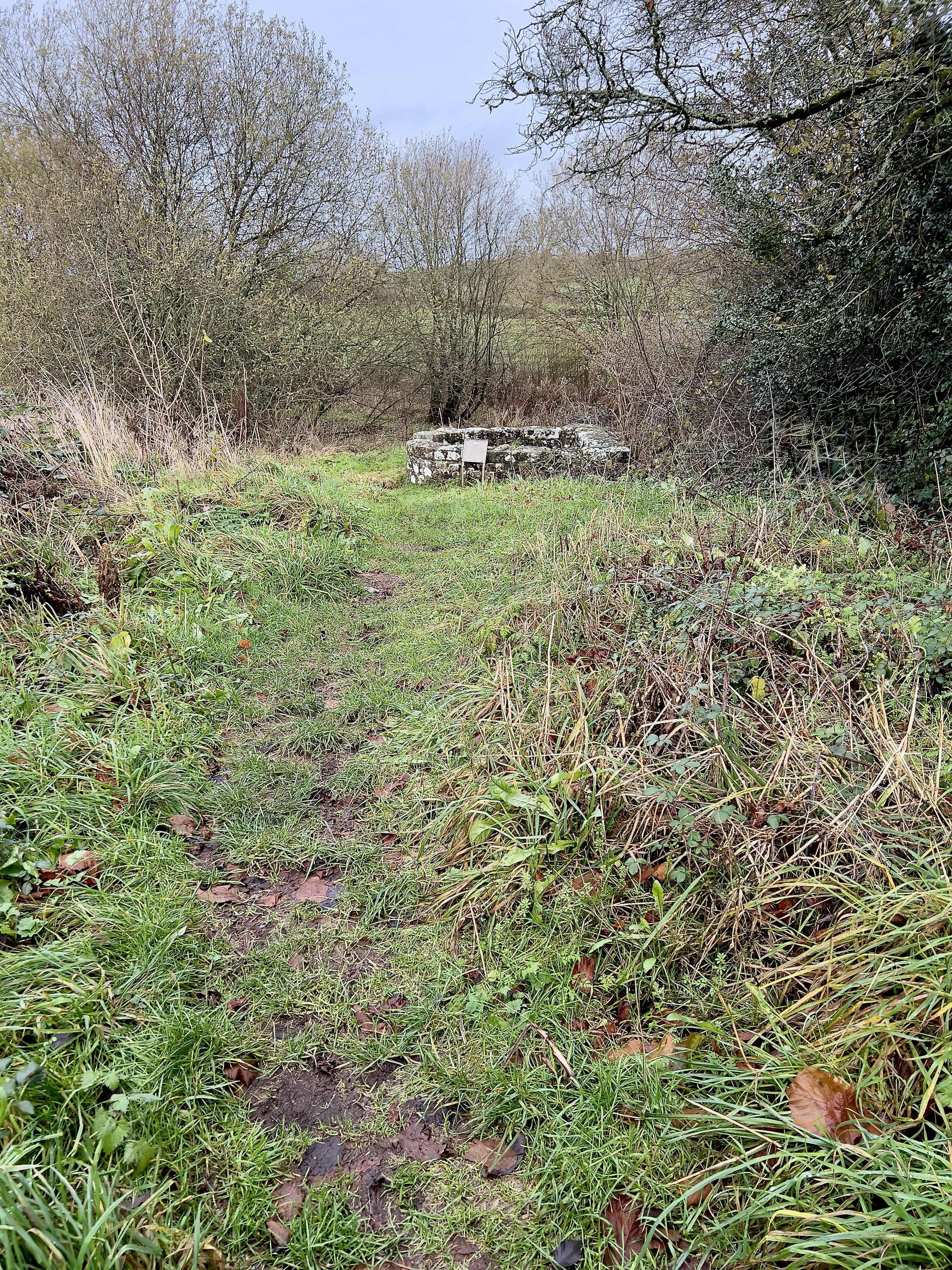
There is no single correct way to be here. Most visitors instinctively slow down, lower their voices, resist the urge to interfere. The water continues its work regardless. Coins appear and disappear. Sometimes the basin is perfectly clear; sometimes rain clouds it briefly. These small variations are part of the encounter.
Reflection: Why Wells Still Matter
In an age of abstraction—digital maps, bottled water, instant explanations—the Virtuous Well offers something different. It is specific. It belongs to this place and no other. Its water has travelled through rock laid down millions of years ago, emerging into a hollow shaped by human hands and beliefs.
Sacred wells endure not because they promise easy miracles, but because they teach attentiveness. They remind us that landscape is not just scenery but relationship; that meaning accrues through repeated, respectful presence.
Standing by the Virtuous Well, you are not required to believe anything in particular. You are invited only to notice: the sound of water, the texture of stone, the way time seems to loosen its grip. In that noticing, something old stirs—not a relic of the past, but a living connection, quietly offered.
When you leave, the well remains, patient as ever, waiting for the next person to pause at its edge and listen.
 Travels With My Aunt
Leave a comment