
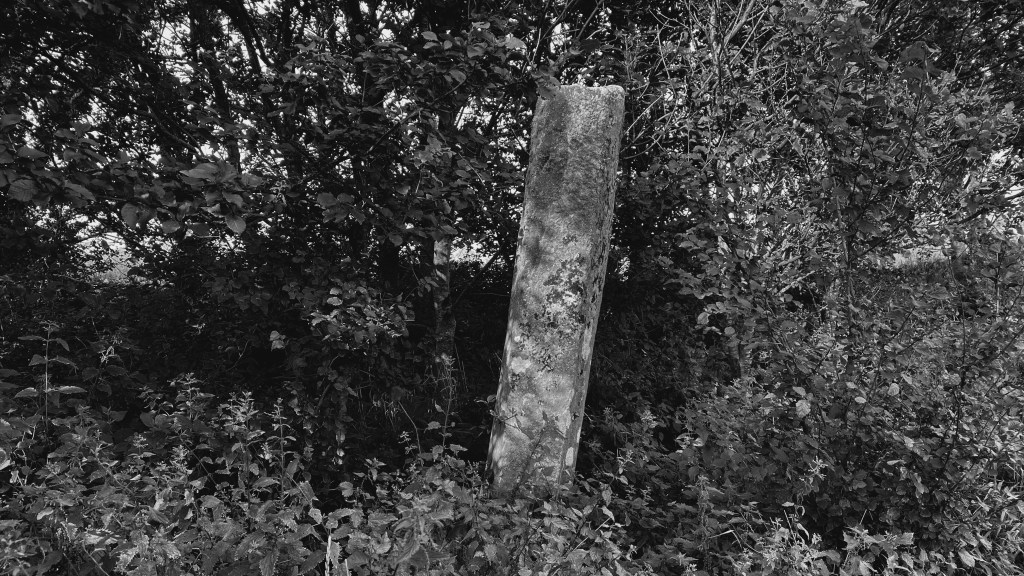
There is something quietly arresting about the stretch of coastal plain just beyond Tywyn in Gwynedd, where the land opens out from the wide beach along the shores of Cardigan Bay towards the mountain range of Cadair Idris and the foothills to the east. Along the line of the modern A493, following what was almost certainly an older routeway, unless you are walking you would easily pass Croes Faen without a second glance. Yet this solitary standing stone, just over two metres tall, holds within it a story that spans millennia, layered with uncertainty, reinterpretation, and quiet persistence.
Croes Faen is depicted on modern and historic (1888 and 1901) Ordnance Survey mapping. It stands in the north corner of a triangular field, in a small copse of trees some 1km north-east of St Cadfan’s Church, right on the edge of the town. The stone is situated on the eastern side of the A493, at a point where the northern end of a former section of road (now straightened) rejoins the current road. Tywyn is where I grew up, and before the road was straightened the Groes Faen was visible from the road. Now it is hidden from view as the traffic thunders past.
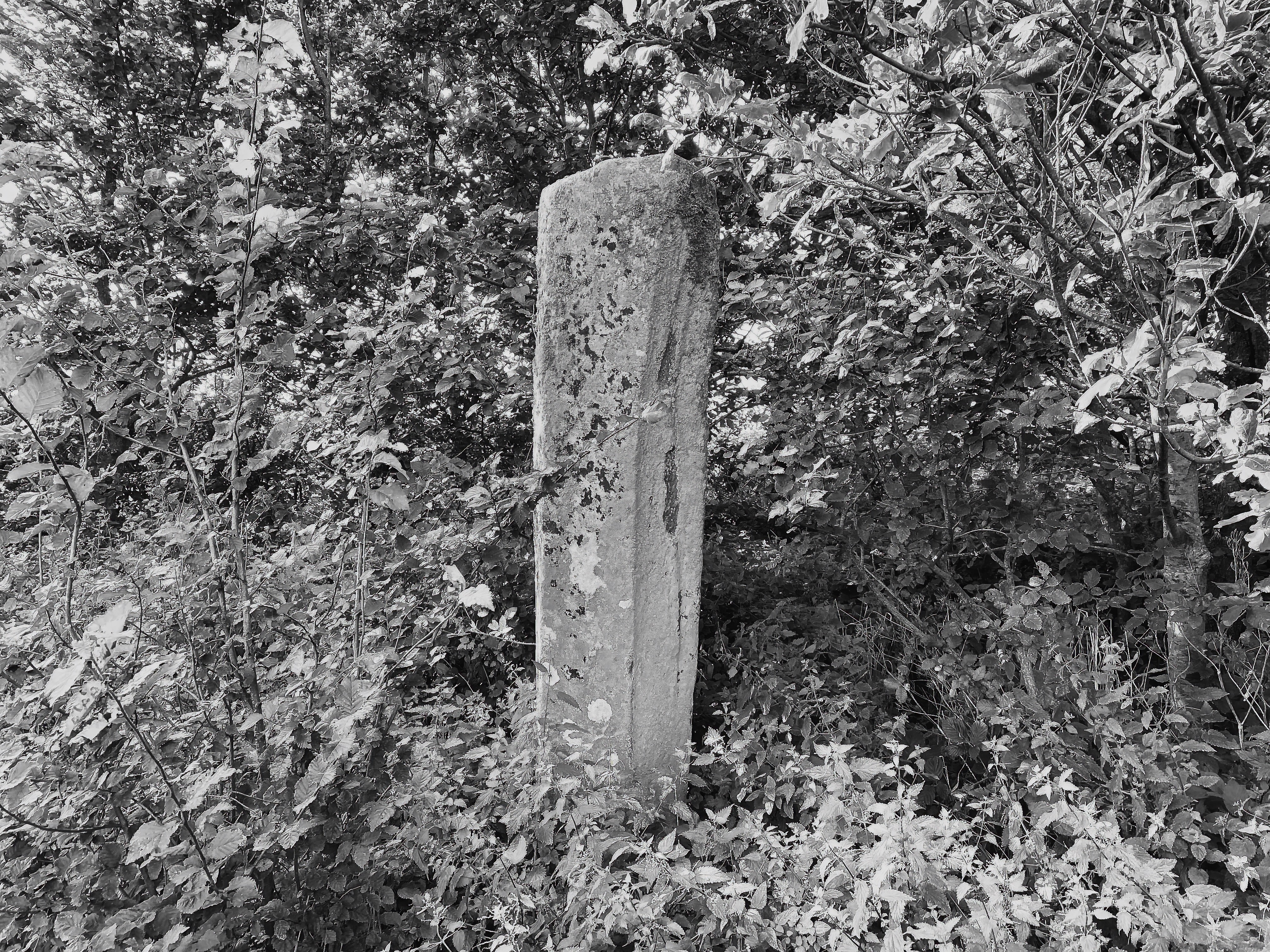
At first encounter, Croes Faen appears deceptively simple: a roughly hewn pillar of stone, its sides faceted into uneven planes, its top flattened by time or design. There are no carvings to guide the eye, no inscriptions to anchor it in a particular century. And it is precisely this absence of clear markings that makes the monument so compelling, but also difficult to date. Archaeologists have long debated whether this is a prehistoric standing stone, perhaps raised during the Bronze Age or the remnant of an early medieval cross-shaft. The Welsh name itself, translating to “stone cross,” hints at a Christian identity, yet the form could easily predate Christianity by thousands of years. And there does not seem to be any missing part to suggest the cross, if existed, was been broken off.
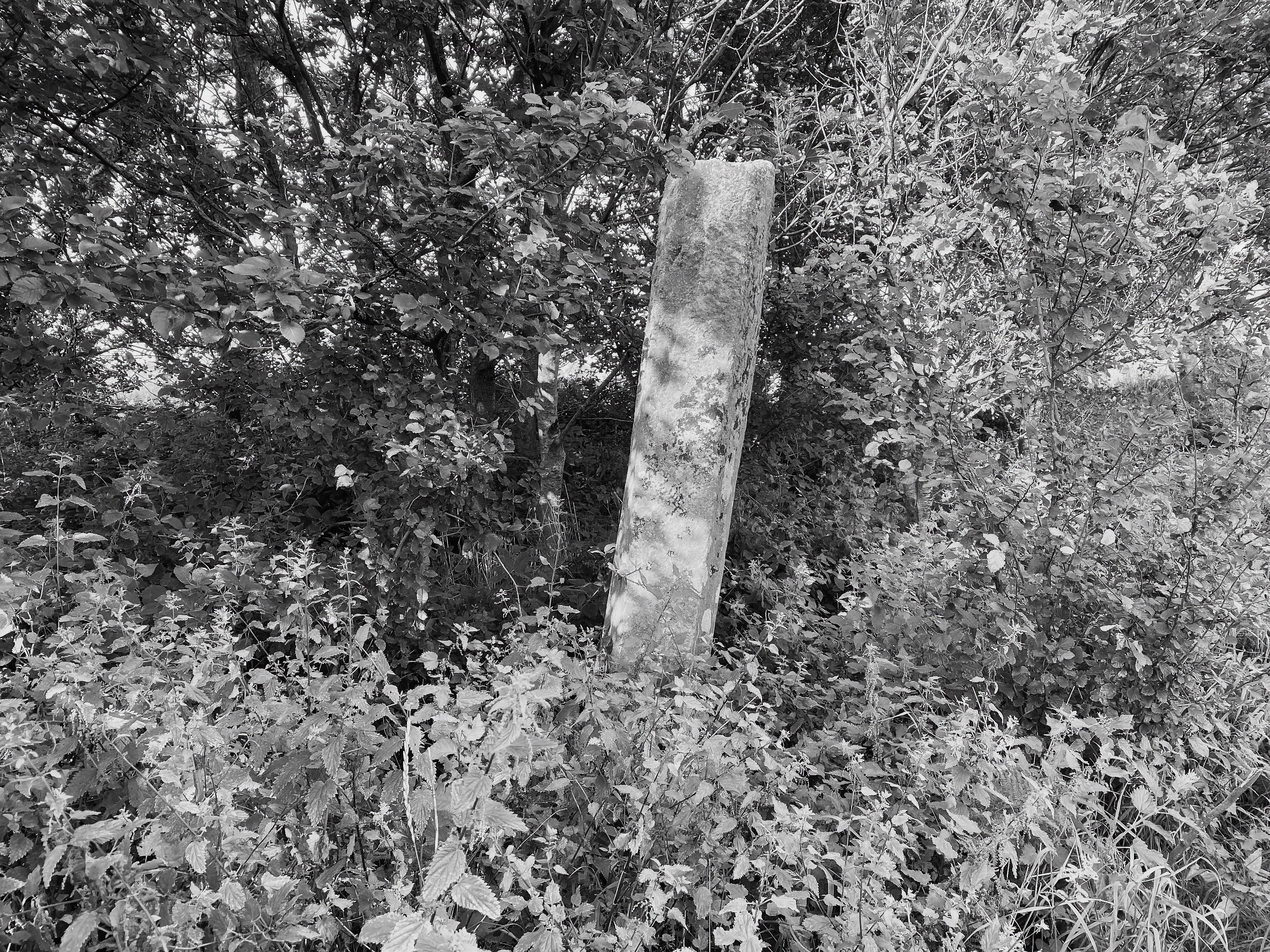
Standing here, with the wind moving across the low ground and the road humming gently nearby, it is not difficult to imagine a much earlier landscape. This part of Gwynedd is rich in archaeological traces: barrows, cairns, and possible cemetery sites lie within a short distance to the west, suggesting that this was once a landscape of burial and ritual. If Croes Faen did begin life as a prehistoric monument, it may have marked territory, commemorated the dead, or served as a focal point within a ceremonial landscape. Such stones were not placed casually; they were positioned with intent, often along routes of movement or in places where visibility mattered.
The possibility that the stone was later adopted into a Christian context adds another layer to its story. Across Wales, early medieval communities frequently established sacred sites in locations already imbued with ancestral significance. Rather than erasing the past, they reinterpreted it—aligning older monuments with new beliefs. If Croes Faen once supported a cross-head, now lost, it would have stood as a marker of this transition: a point where prehistoric memory and Christian identity briefly converged.
Looking closely at the stone itself, its rough multi-sided form raises further questions. Are these facets the result of deliberate shaping, perhaps to create a more regular shaft? Or are they the product of natural fracture, weathered into apparent symmetry over centuries? Without excavation or detailed analysis, the answer remains elusive. What lies beneath the ground—whether a carefully packed socket or a more rudimentary base—could transform our understanding, yet for now the monument keeps its secrets.
Its placement beside a long-established route is unlikely to be coincidental. Ancient trackways often became the skeleton upon which later roads were built, and standing stones frequently marked such lines of movement. For travellers in the past, Croes Faen may have served as a waypoint, a boundary marker, or even a place of gathering. Today, as cars pass by on the other side of the small protective copse, the stone continues to occupy this liminal space between movement and pause, between noticing and overlooking.
Local folklore, as so often in Wales, has stepped in where archaeology falls silent. One story tells of a “fiery dragon” that once plagued the area, with the stone somehow instrumental in its defeat. It is a vivid, almost cinematic image, and one that speaks to a long tradition of attaching mythic narratives to ancient monuments. Such tales do not aim to explain the stone in a scientific sense; rather, they weave it into the cultural imagination, ensuring that it remains a living part of the landscape rather than a forgotten relic. I haven’t read of any dragons attacking Tywyn so perhaps the stone continues to fulfil its role and function.
There are also hints of more recent interventions. Nineteenth-century accounts suggest that the stone may have been moved around 1840 before being returned to its original position. If true, this episode reflects a period when attitudes to antiquities were shifting—when stones could be displaced for convenience or curiosity, only to be later recognised as heritage worth preserving. Even in this, Croes Faen demonstrates its resilience: displaced perhaps, but not erased.
Over time, the stone may have taken on more practical roles as well. Like many standing stones, it has been suggested that it served as a rubbing post for cattle, its ancient surface pressed into service by the rhythms of agricultural life. This quiet repurposing does not diminish its significance; if anything, it reinforces the idea that such monuments are not frozen in time but continue to participate in the everyday lives of the communities around them.
There is even a suggestion that the nearby place-name Ynys Maengwyn—“white stone island”—may derive from this very monument, hinting at its prominence within local geography and memory. Whether or not this connection can be firmly established, it speaks to the way a single stone can anchor itself within both language and landscape.
Another option could be as a boundary marker for the religious establishment in Tywyn in the medieval period. It may have marked the boundary of sacred land, the outer edge of the territory belonging to Cadfan’s clas. In early Wales, such boundaries were not merely practical—they were spiritual and legal. To cross them was to enter a place set apart, where different rules might apply, where sanctuary could be claimed, and where the presence of the church extended beyond its walls into the fields and pathways around it. Cropmark features some 350m to the north-north-east of Croes Faen comprise up to five square barrows, thought to possibly represent an early medieval cemetery. A fact I was unaware of before researching for this posting.
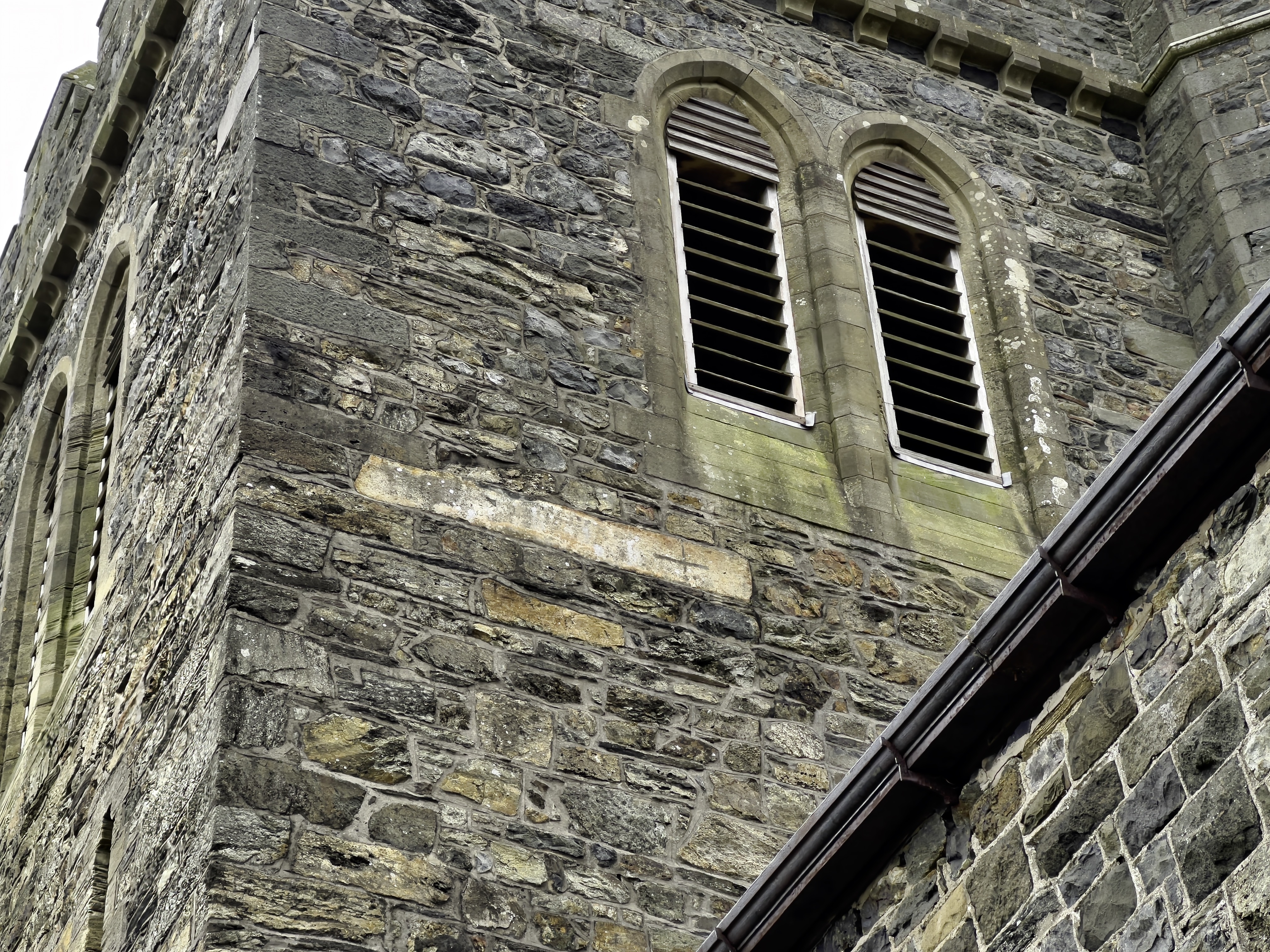
Another standing stone was found in Tywyn, known by archaeologists as Tywyn 3, was found where Tywyn Hospital now stands on Bryn y Paderau. It was here, buried in the earth, that a tall stone once lay hidden. When it was uncovered, what emerged was not an elaborate monument, nor something immediately grand, but a simple pillar—weathered, upright, and marked near its top with a carved cross. Today, that stone is no longer on the hillside. It has been taken into the fabric of St Cadfan’s Church, set into the tower as if drawn back to the centre from which it once radiated. But its story still belongs as much to the open slope of Bryn y Paderau as it does to the church walls.
Tywyn was the site of one the earliest recorded class’ in Wales. A clas, a Celtic religious community and was founded in the 6th century by Saint Cadfan. He arrived from Brittany, part of that great movement of early saints who crossed the sea to establish Christian communities along the western fringes of Britain.
What Cadfan created here was not simply a church, but a living community—part monastery, part local centre of learning and worship. The clas at Tywyn would have been woven into the rhythms of the landscape: prayer and agriculture, scholarship and kinship, all bound together in a distinctly Welsh form of Christianity. From here, Cadfan is said to have founded a wider network of religious sites, including the monastery on Ynys Enlli (Bardsey Island), the “island of saints” lying out beyond the Llŷn Peninsula.
The clas at Tywyn was significant enough to be targeted by Viking Raiders. The most direct reference comes from the year 963, when the church was reportedly attacked and plundered by Viking raiders. The account is terse, typical of early medieval chronicles. It does not dwell on detail or drama. But its very inclusion tells us something important: Tywyn was significant enough to be targeted.
What makes Croes Faen so fascinating is not that it offers clear answers, but that it resists them. It stands at the intersection of multiple narratives: prehistoric ritual, early medieval Christianity, rural folklore, and modern heritage. Each layer adds depth without fully obscuring what came before. In this way, the stone becomes less an object to be categorised and more a conversation across time.
To visit Croes Faen is to encounter this conversation in situ. The setting is unassuming, the monument modest, yet the sense of continuity is palpable. The same winds that move across the fields today would have stirred around its base thousands of years ago. Generations have passed it, paused by it, reinterpreted it—and still it stands, offering no definitive explanation, only presence.
In the end, perhaps that is its greatest significance. Croes Faen reminds us that landscapes are not static but layered, shaped by successive acts of meaning-making. Some monuments proclaim their purpose loudly; others, like this one, endure in quiet ambiguity. And in that ambiguity lies their power—inviting us not just to observe, but to wonder.
Further Reading
CAHMW (Royal Commission on the Ancient and Historical Monuments of Wales), Coflein Database Entry for Groes Faen
https://coflein.gov.uk Accessed March 2026
Cadw, Scheduled Monuments in Wales: Understanding and Protection https://cadw.gov.wales
Burl, A. (2000), The Stone Circles of Britain, Ireland and Brittany, Yale University Press
Bradley, R. (1998), The Significance of Monuments: On the Shaping of Human Experience in Neolithic and Bronze Age Europe, Routledge
Edwards, N. 2013, A Corpus of Early Medieval Inscribed Stones and Stone Sculpture in Wales: Volume III North Wales.
The Modern Antiquarian, Croes Faen (Groes Faen) Standing Stone. https://www.themodernantiquarian.com Accessed March 2026.
Ancient Monuments UK, Croes Faen Standing Stone, Tywyn https://ancientmonuments.uk Accessed March 2026
Coflein. Croes Faen. https://coflein.gov.uk/en/sites/302713 Accessed March 2026
 Travels With My Aunt
Leave a comment