
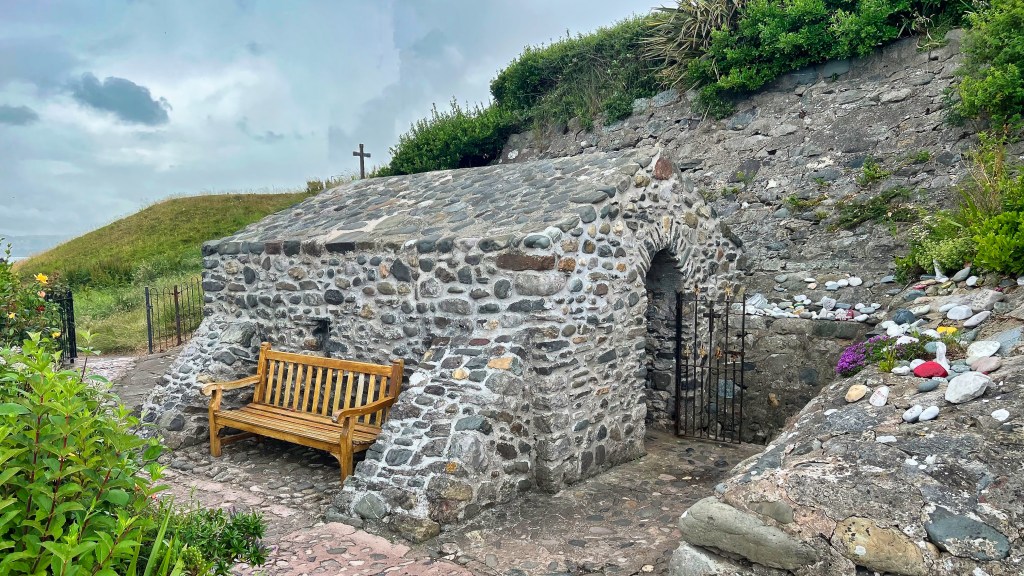
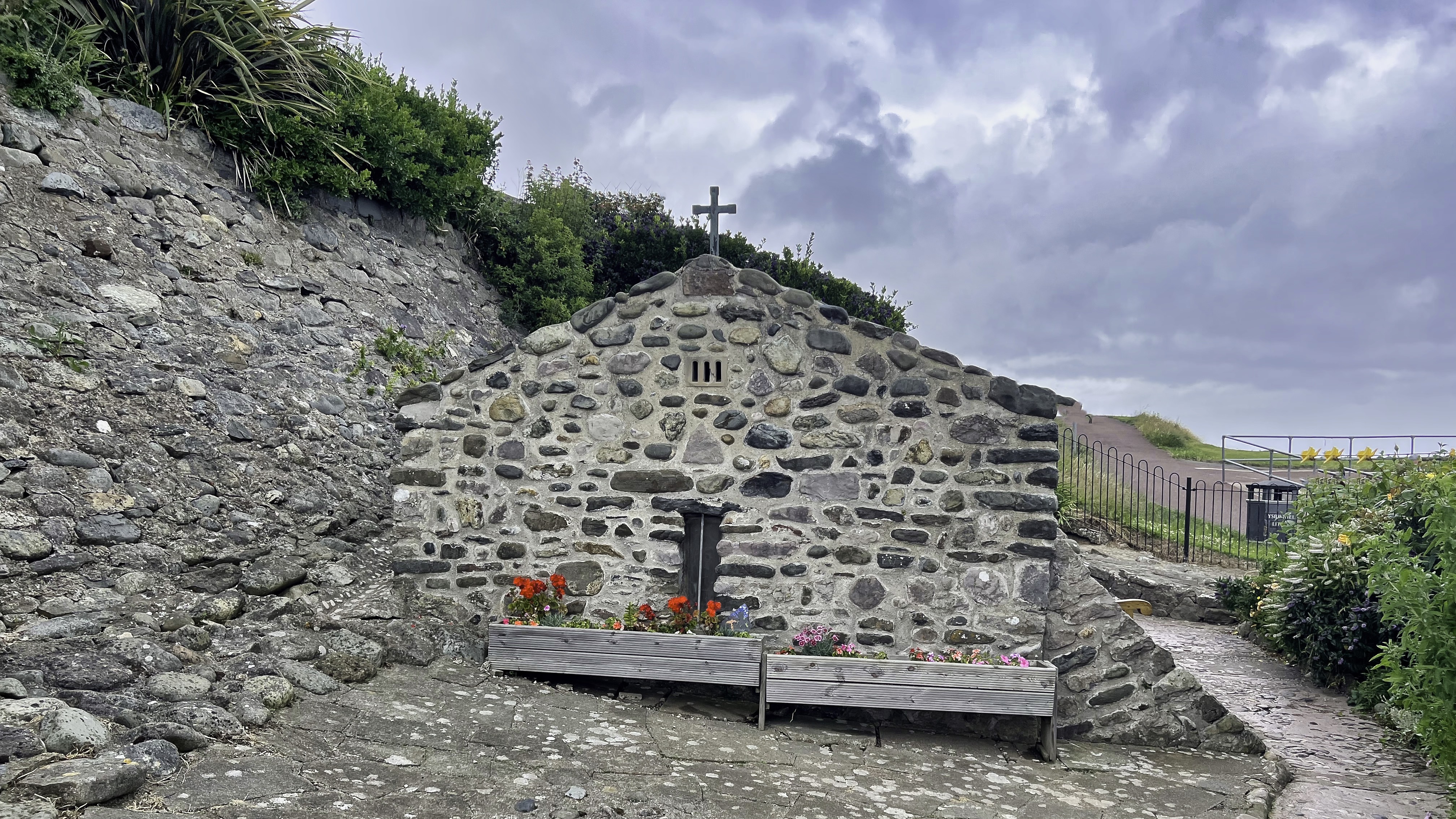
Not only does Wales boast the smallest city on the UK, St David’s; or the smallest cathedral, St Asaph’s, but we also have arguably the smallest chapel – St Trillo. And when we say small, think tiny. Sitting almost in the sea protected only by the concrete sea defences to the north and tucked into an embankment behind it would be easy to miss as you walk along the main promenade path above. What is visible today has been heavily restored over the years with most dating from the 16th century when the current structure was built by the Cistercian monks of Aberconwy Monastery. However, it is possible that this replaced an earlier building, but yet there is no evidence for it. Further restoration was completed in 1935 by William Thomas Havard, Bishop of St Asaph. The simple structure seemingly takes its instead roots directly from the beach with the walls being built using round beach stones. It’s almost as it it has grown from the beach itself.

We almost missed the chapel while walking this stretch of the Wales Coast Path. If we had not diligently walked as close to the sea as we could and followed the wider promenade path higher up on our way to the cafe for lunch, then this gem would have been missed. Today it is completely dominated by the lower promenade and wide tarmac walkway with the wall supporting the upper promenade and road overshadowing this tiny building. The town of Rhos-on-Sea has grown above and around it, with only the sea immediately to its north to suggest its position here. In the 5th and 6th centuries there would have been very little population here on this exposed coast, but the sprig water that flows from the rocks here would have been valuable resource, and as such quite possibly an ancient sacred site.

So how small is the chapel? At only 4.6×2.7m (15x9ft) you won’t get many people into the service, and there are 6 chairs kept in the chapel to illustrate how compact it really is. Any more than this, even standing, for a service you would quickly get to know everyone in the congregation. With only Aunty and myself inside it already felt crowded, but the thick walls created a barrier between us inside and the world outside. It is still consecrated, and holds service and baptisms throughout the year. Looking towards the simple altar you immediately notice there is a square hole which leads down into St Trillo’s Well. The water is now used for baptisms and church services, but would once have been used by the wider community as a safe and regular source of drinking water. Most of the wells we have visited in these blogs have been isolated and hidden away in remote areas of Wales. Just above the embankment is a busy road, and the town on Llandrillo-yn-Rhos, or as it now known Rhos-on-sea. But St Trillo’s stands in plain sight, but even so it seems remote and other worldly, somehow disconnected from the many people walking past along the promenade. A place that is ignored and missed.
St Trillo, also known as Triel or Trillo of Llandrillo, is believed to have been born in the sixth century in Armorica, a region in modern-day Brittany, France. It is thought Trillo was the son of Ithel Hael, a prince of Armorica. Ithel Hael was a busy man and had many children, Baglan, Flewyn, Gredifael, Tanwg, Twrog, Tegai, Trillo, Tecwyn, and Llechid. For some reason the whole younger generation decided to leave Armorica and accompany St Cadfan to Wales to spread the gospel. We have encountered Tanwg and Tecwyn before in this series of blogs as they founded two of my favourite church sites. According to legend, during St Trillo’s travels, an angel appeared before him and told him to seek out a location by the sea for the establishment of a place of worship, eventually arriving in what is now Rhos-on-Sea. It is said that he arrived on a small stone boat that miraculously expanded to accommodate him and his companions. Always good to have an expanding boat, especially if it is made of stone.
If Trillo really did settle here he may have raised and enclosure around his cell so that he could farm to feed himself and his followers. This enclosure was known as a “Llan”, a word we see on a regular basis throughout Wales, and later became associated with the church building itself. Rhos means marsh so Llandrillo-yn-Rhos (the Welsh name of Rhos-on-Sea) means “St Trillo’s enclosure by the marsh”, as the surrounding was originally very marshy. Trillo is also associated with another church in Llandrillo. This is 40 miles south of St Trillo’s Well, though is has been questioned by recent historians whether St Trillo did establish a church here. Mind you if you’ve travelled from Brittany a 40 mile track into the heartlands of Wales would not be a very daunting or difficult journey.
 Travels With My Aunt
Leave a comment