
Auntie was away for a week with her girls and I was left unsupervised for a week. So I kidnapped Wilf the Dog and we set off in the motorhome for a couple of days to Pendine. It has a fantastic beach where Wilf can run his legs off, which he did. I hadn’t planned on a pilgrimage on the first day, just a wander along the coast path above Pendine, where the air smells of sea and salt. But the tide was in, smothering the beach beneath a slow-heaving sheet of grey water, so the cliffs were my only route to a set of Neolithic tombs high on the cliff above Gillman Point. Two brutally steep climbs along the path left me wheezing and questioning my life choices. If Aunty had been with me, I’d have heard endless complaints of “Why are we looking at scabby stones again?” Thankfully, I suffered alone, and Wilf was in his element. Mind you, I should have remembered what this section was like when Aunty and I completed this section of the Wales Coast Path in 2019.
Up here on the cliff tops, where the Wales Coast Path skirts innocently along the cliff edge, there is no hint of what lies hidden just a little way off. When Aunty and I walked along this section of the Wales Coast Path (https://paulchallinor.com/2025/11/27/castles-coalmines/)I was unaware they were here. There are no signposts. No crowds of tourists, No easy footpaths to the tombs. Only tall bracken, ankle-breaking rocks and the feeling that something is watching you from deep time. I’d come in search of the Morgan Bychan Neolithic burial chambers—ancient tombs that the landscape keeps tucked away from the casual stroller. Finding them felt like a test of commitment. Finding them involved pushing through thigh-high bracken, scanning for unnatural lines and the tell-tale geometry of human hands in a wild place. Not easy when there are slabs of naturally sited lime stone scattered among the blanket of Bracken. When the first stones finally emerged, their heavy slabs dark under the overcast sky, the effect was quietly satisfying.
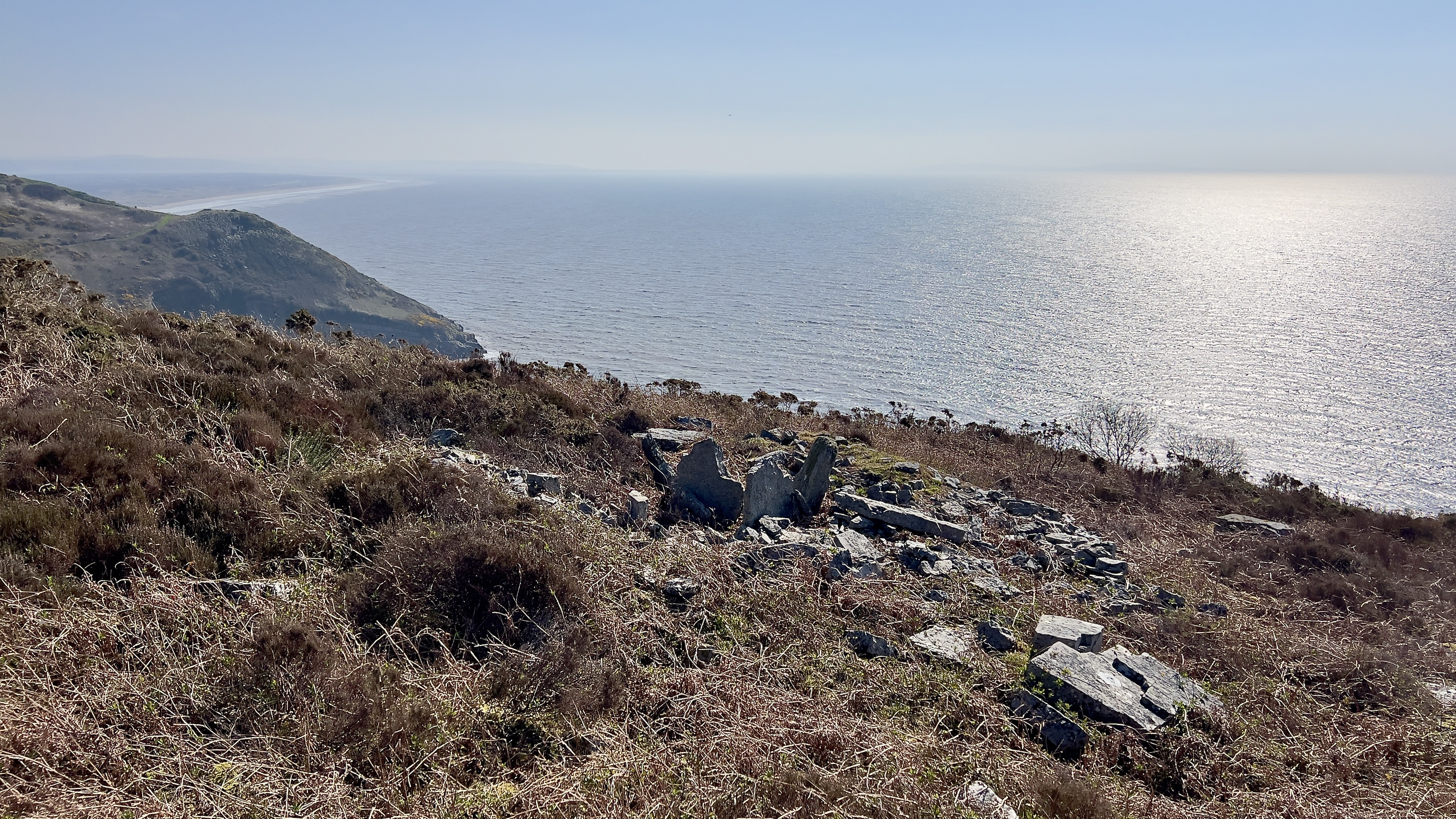
I stood there, just above the hush of the sea below me, looking at structures older than the pyramids, older than most of our myths. And I wondered—how close, really, are our interpretations of these places? Without a Wellsian time machine, we can only stand and guess. The Morfa Bychan burial chambers sit on a shelf at the cliff top, looking out over Carmarthen Bay. The coordinates might be 51.735°N, 4.556°W, but what matters more is the sensation of standing between worlds: land on one side, sea on the other, and beneath your boots the quiet persistence of the Neolithic Age.
Their position feels deliberate. The views are astounding, yes, but the site also occupies that liminal frontier so often chosen in the Neolithic for ritual spaces. The unknown border between water, land and sky. But the site is also probably influenced by the easy availability of building materials, with rocks laying all around waiting to be used. South-west Wales is thick with such monuments, forming a network of cairns, passage graves and standing stones that once bound communities together across the coastline. These tombs were not isolated curiosities; they were part of a wide cultural landscape of trade, ceremony and ancestral memory.
Built around 3500–2800 BCE, the chambers belong to the Middle to Late Neolithic. Archaeologists date them through charcoal traces, typological comparisons and the stratigraphy that whispers of phases, alterations and centuries of use. The people who constructed them returned to them again and again—burying, honouring, perhaps feasting, perhaps storytelling—layering generations into the same sacred spaces. This is all conjecture, but the degree of effort required to build these stone monuments surely have encouraged their use by the community over a protracted time period.
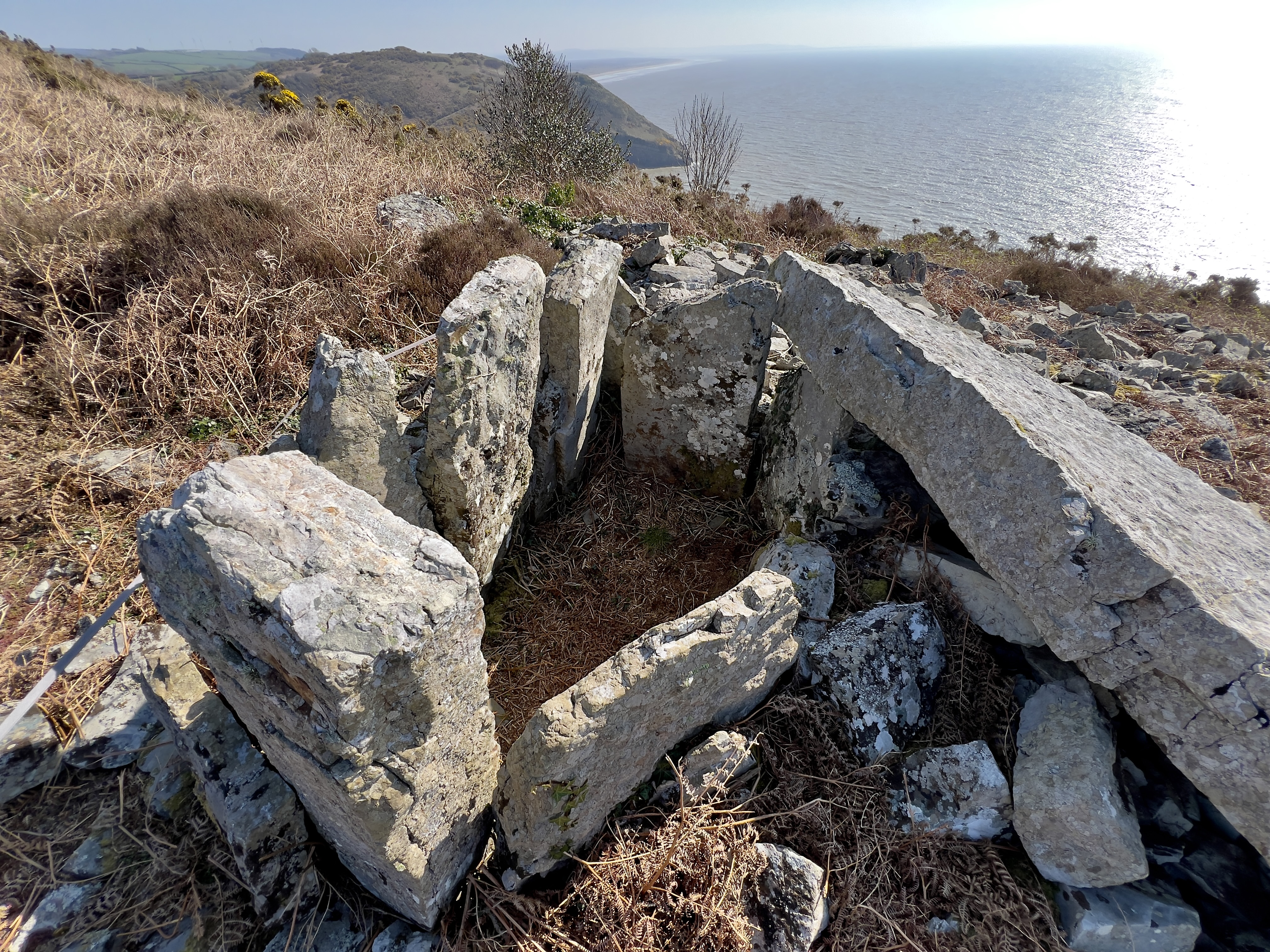
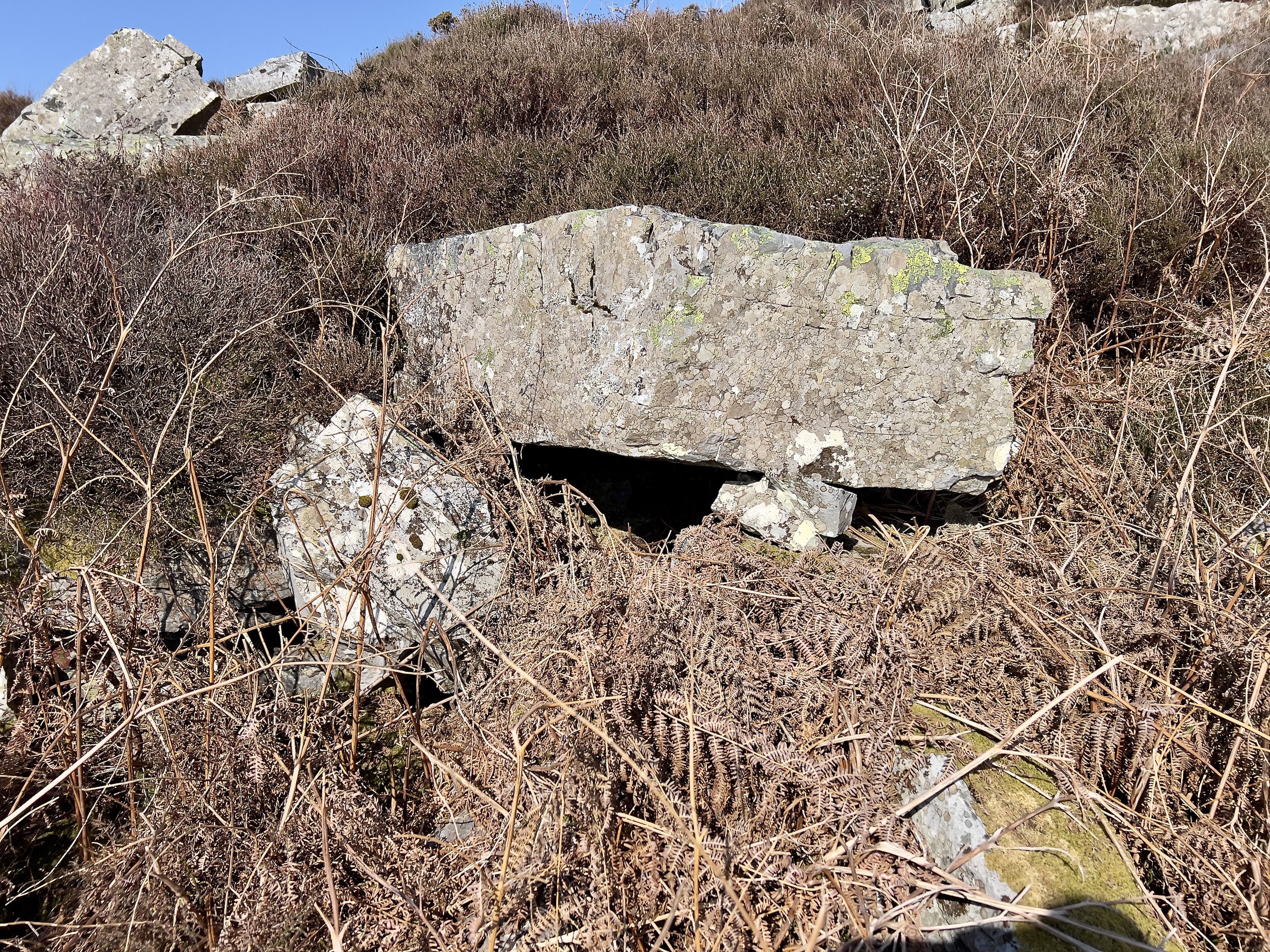
There are 4 tombs recorded here at Morfa Bychan. But with the bracken and hidden ankle breaking traps I only found two. And as I’m pretty useless at this I’m not even certain which ones I have found. But I think I have found the southernmost chamber which appears shy beneath its oval cairn of boulders and surrounding bracken. Nine uprights enclose a compact, grave-shaped interior. There’s no obvious entrance—only the suspicion that a western stone may once have been a small opening, a symbolic portal rather than a practical one. The fallen capstone now leans lazily against the structure, as though tired of the burden of millennia.

Forty metres north, the second tomb sits within a circular cairn of small, rounded stones. The chamber inside rises from seven tall uprights with pointed tops. Its capstone, too, has slipped to the southern edge like a discarded shield. A few stray stones to the west may hint at a once-connected feature—or may simply be the whimsy of geology. Here, ambiguity reigns.
Further along the ridge, just south of a rocky prominence known as The Druid’s Altar, lie the remnants of a smaller cairn. What survives is low, stony, and unassuming, the capstone long gone. Yet the remaining uprights still describe the ghost of a chamber. Needles to say we didn’t find this one.

The northernmost tomb is often described as the most impressive—and the most intact. However, Wilf and I were getting bored of fighting our way through the vegetation and didn’t get this far. The literature describes it as partly sunk into the earth, with a rectangular chamber formed by propping a great natural slab upon smaller stones. A short passage leads outward from its shadowed interior. Here, uniquely at Morfa Bychan, the capstone still rests exactly where Neolithic hands placed it.
Three of the four tombs were opened in 1910. Treherne’s excavation of the northern chamber uncovered a stone-lined entrance sealed by a slab, while Ward’s investigations in the south revealed a paved floor, flint flakes, and a hammer-stone. All humble artefacts, perhaps, but each one a tangible link to the rituals once enacted here. The finds now rest in the National Museum of Wales.
More modern surveys confirm what those early archaeologists guessed: these tombs saw repeated use, with evidence of multiple burials, pottery sherds, polished axe fragments and later disturbances suggesting Bronze Age or even early medieval reuse. Ancestors do not always sleep undisturbed.
What do we make of these chambers today? Scholars generally see them as communal monuments—places where identity was forged through shared ancestry. They were not built for individuals but for communities. The alignments of the chambers, their inter-visibility with other monuments, and their commanding views over sea and hinterland all point toward a ritualised landscape, linking the living with the dead and both with the turning of the sun.
The Severn-Cotswold tradition of passage graves to which these chambers belong is part of a widespread Neolithic architectural language. Yet each site has its quirks, its local choices, its nods to the character of the land. Morfa Bychan is no exception—a series of tombs built on the cliff top, near water, near trade routes, near beauty.
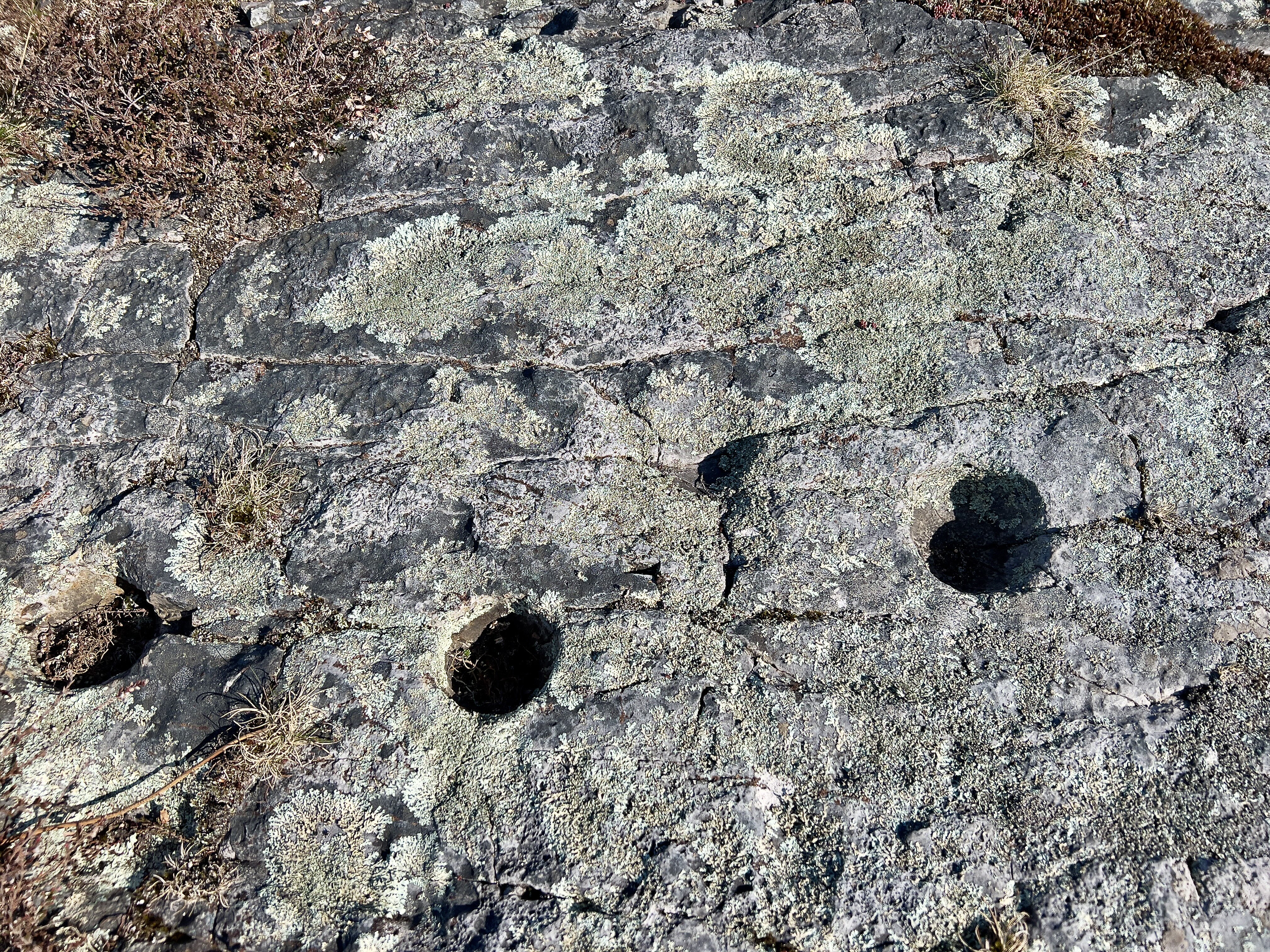
Just above the burial chambers there is what is thought to be series of cup marks carved into a large stone on top of the cliff. This was been conjectured by some, but I can’t find any definitive answer to this debate. Cup shaped they certainly are, and deep as well. But much deeper than cup marks I seen elsewhere. I’d have expected more wear after all this time.
Standing among them, bracken brushing my knees and the wind tugging at my sleeves, I felt something that academic descriptions never quite capture: the presence of intention. Someone chose this place for a reason. Thousands of years later, that reason still resonates—quietly, insistently, across the gulf of time.
Further Reading
Bradley, R. (1998) The Significance of Monuments: On the Shaping of Human Experience in Neolithic and Bronze Age Europe. London: Routledge.
Burrow, S. (2006) The Tomb Builders in Wales 4000-300BC. National Museum of Wales Books.
Cummings, V. & Whittle, A. (2003) Tombs with a View: Landscape, Monuments and Society in Neolithic Brittany. Oxford: Oxbow Books.
Lynch, F., Aldhouse-Green, S. & Davies, J.L. (2000) Prehistoric Wales. Sutton Publishing Ltd.
Nash, G. (2006) The Architecture of Death: Neolithic Chambered Tombs in Wales. Logaston Press.
Rees, S. (1992)A guide to Ancient and Historic Wales: Dyfed. HMSO Publications.
 Travels With My Aunt
“Why are we looking at scabby stones again?” that made me laugh. Those holes are very interesting. How deep do they go? Are they symbolic extrances and exits, I wonder?
LikeLike
To be honest Emma, I have no idea what they were for. I’ve seen them before on a few tombs and scattered stones. In fact I’ve just become aware of a stone on the ridge of one of the South Wales valleys not far from where I live – a trip is need I think. From what I’ve ready the boffins class them as ‘ ritual use’. I doubt they were used to hold the beer glass during a BBQ, so their enigmatic use will have to remain a mystery.
LikeLiked by 1 person
My friend writes a blog called Stone Folklore. I will ask her, but as you say, it is probably covered by “ritual” https://wp.me/pgEB0A-3
LikeLike
That sounds like my sort of blog. I’d be interested to hear what she thinks.
LikeLiked by 1 person